The Small Business Crisis Turnaround: How to Use AI to Build a Fast Damage Control Strategy
A stressed founder's playbook for AI crisis management for small business — sentiment triage, human-sounding apologies, and a 3-month reputation recovery plan you can start in the next hour.
Your stomach is in your throat. The notifications won't stop. A customer screenshot, a one-star review, a local reporter's DM — whatever lit the fuse, the fire is yours now. Breathe. You have more leverage than you think, and you can build a credible damage control strategy before lunch.
This guide is the playbook. Not theory. AI crisis management for small business is not a marketing buzzword anymore — it is the only reason a two-person company can respond at the speed of a Fortune 500 comms team. We'll move from triage to public statement to long-term brand reputation recovery, with copy-and-paste prompts at every step.
The First 4 Hours: Immediate Triage Using AI
Panic distorts scale. A loud thread on X feels like the end of your business. Usually it is not. Your first job is to size the threat honestly, and AI is faster than any human reading through 400 angry comments at 11pm.
Imagine a local bakery dealing with a viral video about a hygiene issue. By morning there are 1,200 comments. The owner can't read them all. She doesn't need to. She pastes them into an LLM and gets a structured breakdown in 90 seconds: how many are customers vs. randoms, what specific claim is driving the anger, and which comments suggest actual lost revenue.
Triage prompt — paste this first
You are a senior crisis communications analyst.

Variables:
- Comments: {{COMMENTS}} — paste all negative comments, reviews, or articles to be analyzed

REQUIRED STRUCTURE — return exactly these sections:
1. CORE CLAIM — the single specific accusation driving the anger (one sentence).
2. SECONDARY CLAIMS — up to 3 related complaints surfacing in the thread.
3. AUDIENCE BREAKDOWN — estimated % from (a) actual customers, (b) people in the business's city/region, (c) random internet users with no connection.
4. SEVERITY (1–10) with one-sentence justification — base severity on revenue risk, not noise volume.
5. FACTUAL VS. EMOTIONAL — what % of comments cite a verifiable fact vs. pure emotional reaction.
6. THE 3 COMMENTS TO RESPOND TO FIRST — quoted verbatim, with reasoning for each.
7. WHAT NOT TO ENGAGE WITH — comment patterns to ignore entirely.

CONSTRAINTS — do not soften the assessment. Do not offer encouragement. Analyze only.

Tone: clinical, unemotional, direct. Length: structured report, one section per heading above.Crafting Your Response Without Sounding Robotic
The 'Own It, Fix It, Prevent It' framework is the spine of every credible apology in the last 20 years. Three beats. In that order. No exceptions.
- Own It — name the specific thing that happened. No 'concerns have been raised.' No passive voice. You did it, or it happened on your watch.
- Fix It — the concrete action you are taking right now, with a date. Not 'we are reviewing our processes.' Something a customer can verify next week.
- Prevent It — the structural change so this doesn't happen again. One specific policy, one named person responsible.
Generative AI is excellent at drafting the press release, the Instagram caption, the internal Slack message, and the talking points for your three employees who will get asked about this at the coffee shop tomorrow. What it is bad at — by default — is sounding like a human being. That is on you to fix in the prompt.
How to Prompt AI to Sound Human, Not Corporate
The default LLM apology is the worst writing on the internet. 'We sincerely apologize for any inconvenience this may have caused.' Nobody believes it. Nobody ever has. Here is the prompt structure that produces something a real person would actually say:
You are drafting a public response from the owner of a small business — not a corporation. Write in first person, signed by name.

Variables:
- Situation: {{SITUATION}} — describe in 2–3 sentences what happened
- Owner name: {{OWNER_NAME}}
- Contact email: {{CONTACT_EMAIL}} — a real email address, not a form

REQUIRED STRUCTURE — use the Own It, Fix It, Prevent It framework:
1. Own It — name the specific thing that happened in plain language. One sentence. No passive voice.
2. Fix It — the concrete action being taken this week, with a date the customer can verify.
3. Prevent It — the structural change so this doesn't happen again: one specific policy, one named responsible party.
4. Close with one sentence inviting the affected person to contact {{CONTACT_EMAIL}} directly.

BANNED PHRASES — do not use: "We sincerely apologize," "any inconvenience," "reach out," "doing better," "our valued customers," "concerns have been raised," "transparency is one of our core values," "we take this seriously," "lessons learned."

CONSTRAINTS — max 150 words. Use "I" not "we" if the business is a solo operation. One short sentence per beat. No emojis. No exclamation points. Do not thank anyone for their "feedback."

Tone: human, direct, accountable. Length: 150 words maximum.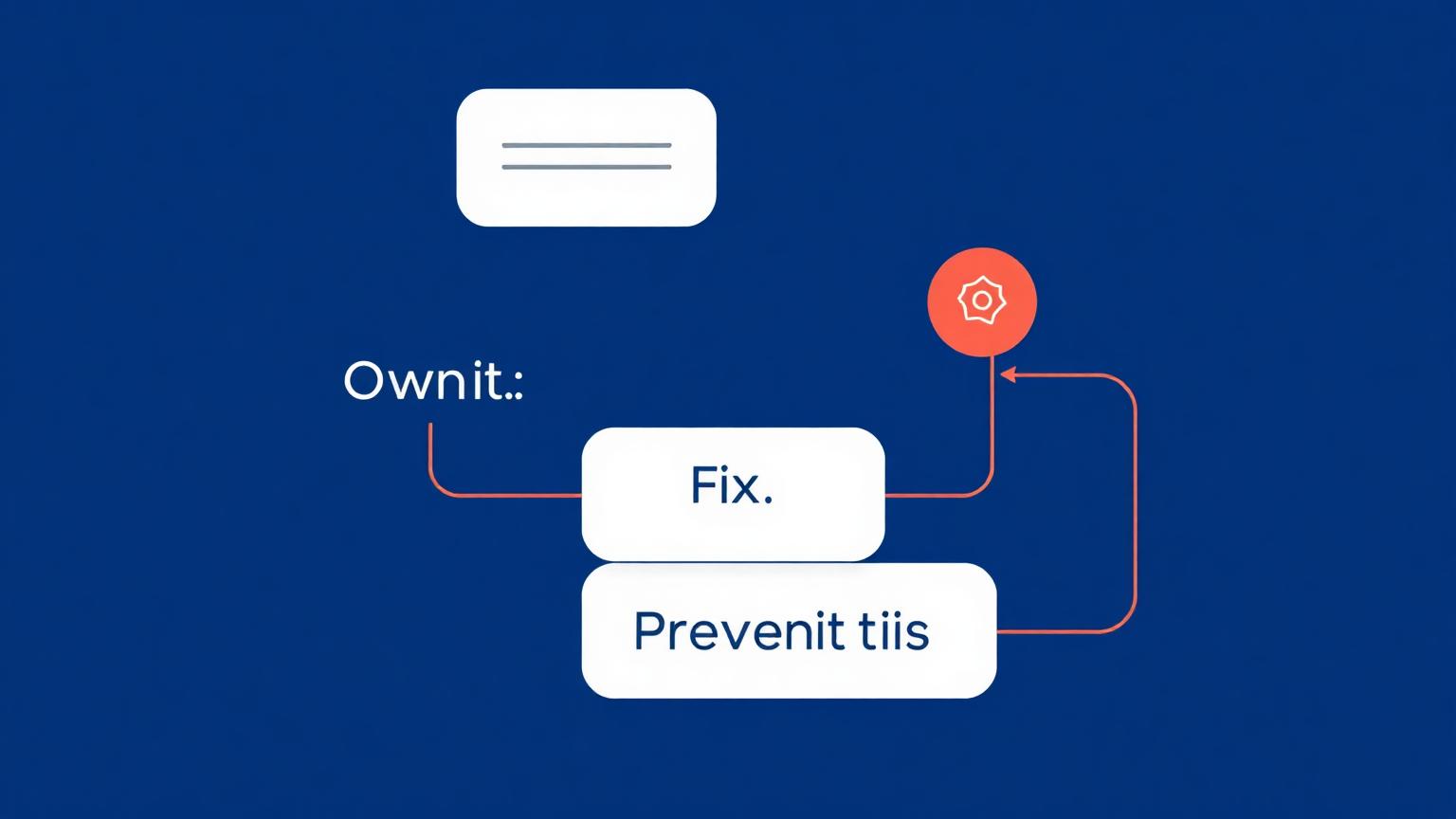
Run the output past one person who is not on your team. If they read it and say 'that sounds like a company,' rewrite. If they say 'that sounds like you having a bad week and being honest about it,' ship it. This is the same discipline behind every client-facing email template that actually gets a reply — specificity beats polish, every time.
Step-by-Step Blueprint for Brand Reputation Recovery
Public relations scandal repair is a chronological game. Skip a step and the next one fails. Here is the order that works whether you're a freelancer with one angry client or a 12-person agency with a Glassdoor problem.
Step 1 — Internal alignment (the next 60 minutes)
Before any public word goes out, your team needs the same script. Staff get asked first — at the school pickup, in the gym, by their own family. If they wing it, you have five conflicting stories by Friday. Draft a 200-word internal memo using the same Own It / Fix It / Prevent It frame, plus three sentences they are allowed to say verbatim if cornered, and one sentence: 'For anything beyond that, please send them to me directly.' Tell investors before they read it on Twitter. Always.
Step 2 — The public statement (timing and channels)
Post on the channel where the crisis is loudest first. If it broke on Instagram, your first statement goes on Instagram. Don't write a blog post if nobody is on your blog. Within 90 minutes of the story reaching critical mass is the sweet spot — fast enough to show you're paying attention, slow enough to not sound reactive. Cross-post within the next 4 hours: your email list (yes, even the bad news — they hear it from you or they hear it from a screenshot), your website, LinkedIn if relevant. Pin the statement. Do not delete comments unless they are illegal.
Step 3 — SEO suppression and the 90-day positive content calendar
Bad press lives on Google for years unless you actively bury it. This is where AI earns its keep. You need 12-16 pieces of genuinely useful content over the next 90 days that target the same search terms a worried customer would type — your business name, your founder name, your city plus your category. Use an LLM to brainstorm the calendar, then write the drafts yourself or with light AI assist. The structure looks like this:
| Month | Content Focus | Format | Target Search Term |
|---|---|---|---|
| Month 1 | Behind-the-scenes process, founder story, customer wins | Short videos + 2 long articles | [Your business name] reviews, [your name] founder |
| Month 2 | Educational content for your category | 1 cornerstone guide + 4 social cuts/week | Category + city, 'how to choose a [your service]' |
| Month 3 | Press, partnerships, third-party validation | Podcast appearances, guest posts, case studies | [Your business] case study, [your name] interview |
If you've already systematized your content production workflow, you can hit this volume without burning out. If you haven't, this crisis is the forcing function. Steal the calendar template, ship one piece a week, and track which keywords move on page 1 of Google. The bad article doesn't have to disappear — it just has to be on page 2.
Top AI-Powered Tools for Small Business PR Crisis
You do not need a $20,000/month enterprise stack. Four tool categories cover almost every social media backlash strategy a solo operator or small team needs. Pick one from each.
| Tool Category | What It Does | Why It Saves Time |
|---|---|---|
| Social listening | Tracks mentions of your brand, founder name, and competitors across X, Reddit, TikTok, news sites in near real-time | Replaces the 4am habit of refreshing every platform manually; alerts you only when volume spikes |
| Sentiment analysis | Scores incoming mentions as positive, negative, or neutral and clusters them by theme | Turns 800 comments into a one-screen dashboard you can act on; surfaces the real complaint behind the noise |
| Generative AI (LLM) | Drafts statements, internal memos, press responses, FAQ pages, and the 90-day content calendar | Cuts a 6-hour writing day to 90 minutes of editing; lets one founder respond at agency speed |
| Review and SERP monitoring | Watches Google/Yelp/Trustpilot review velocity and tracks where the bad article sits in search results | Tells you week-over-week whether the SEO suppression plan is actually working, without checking 12 tabs |
A note on the AI-powered PR tools market: most 'crisis dashboards' marketed to small businesses are general listening tools with a new landing page. Don't pay $400/month for a rebrand. A free Google Alert plus a $20 ChatGPT subscription plus a $30/month listening tool covers the same ground for under $60. The frameworks in this guide matter more than the software. If you want to keep the rest of your operation moving while you handle this, the weekly admin cleanup prompt and the full prompt library are where to start.
Conclusion & Next Steps
A crisis is a brutal way to find out what your business actually stands for. Handled with speed and honesty, it can become the most trust-building chapter of your company's story. Customers don't expect perfection. They expect humans who own mistakes and fix them publicly. That is a bar small businesses can clear better than any corporation, and AI is what finally levels the speed gap.
Before you close this tab, do these things in this order:
- Run the triage prompt on the actual comments. Right now. Get the severity score.
- Draft the internal memo using Own It / Fix It / Prevent It. Send to your team in the next 60 minutes.
- Draft the public statement with the banned-phrases prompt. Show one outside person. Ship within 90 minutes of the story peaking.
- Open a doc titled '90-day content calendar.' Write 12 headlines tonight.
- Set one Google Alert for your business name. Set another for your founder name. Free, takes 60 seconds.
- Sleep. The crisis will still be there. So will your plan.
If the last few days have shown you how much of your week disappears into reactive work, that is a separate problem worth solving on the other side of this. The Solopreneur Burnout Workflow Auditor takes 3 minutes and surfaces exactly where the hours are leaking.
Frequently asked questions
- Both are wrong as blanket rules. The honest answer: respond within 90 minutes of the story reaching the people whose opinion costs you money — your customers, your local market, your investors. Not within 90 minutes of the first angry tweet. Use the triage prompt to figure out which moment that actually is. A premature statement on a story that would have died in 6 hours pours gasoline on it. A slow statement on a story that has hit local news makes you look guilty. Speed is a function of audience, not of the clock.
SoloPromptAI creates practical tools and guides for getting clearer, more useful results from AI—without the prompt-engineering theater.